This article contains affiliate links. If you buy through them, we may earn a commission at no extra cost to you. Learn more.
Buyer's Guide
Confused about IPTV subscriptions? Here's exactly what they are, how they work, what to check before paying, and how to get the right one for your TV, Firestick, or phone.
In Brief
- IPTV delivers live TV over the internet via an M3U playlist or Xtream Codes login — it replaces cable, not Netflix.
- A 24-hour free trial is the single most important test: use it to check buffering, EPG, and channel quality before paying.
- The most reliable starting setup is a Firestick, a $15–20 monthly plan, and a player like TiviMate or IPTV Smarters.
- Legality varies by provider and country — buy from sellers that are transparent about licensing, and avoid anything that feels like a gray-market deal.
In this guide
Buying an IPTV subscription is one of the most effective ways to cut the cord — but only if you choose the right provider. IPTV, or Internet Protocol Television, delivers live TV channels over your broadband connection instead of through a cable box or satellite dish. It works on devices you already own: Firestick, Samsung Smart TV, Android, iPhone, PC, and even a cheap streaming box. The catch is that the market is crowded, and the quality gap between a good and a bad provider is enormous.
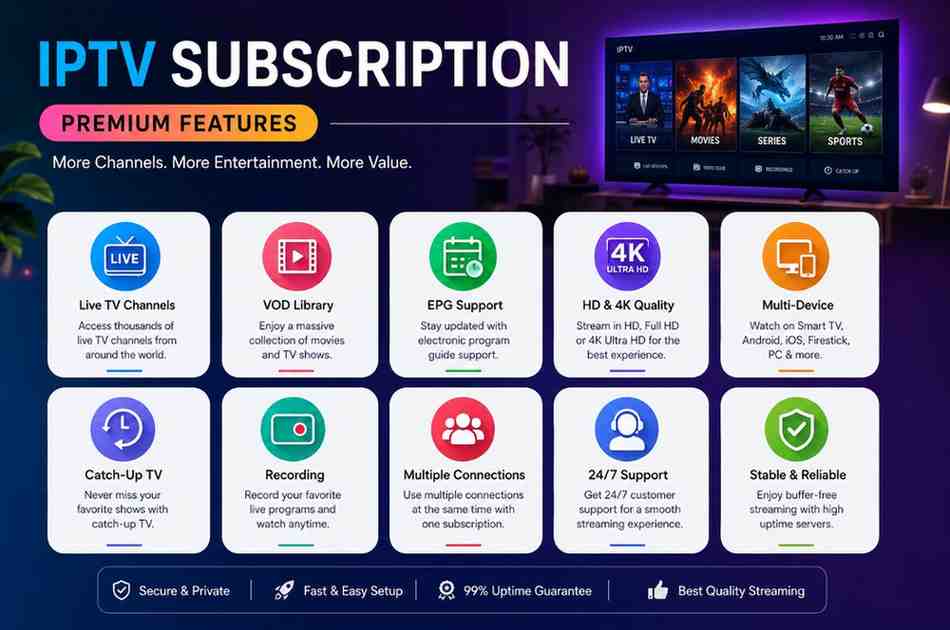
IPTV isn't a single app or company — it's a delivery method. When you buy an IPTV subscription, you're paying for access to a server that streams live television and on-demand content to a media player of your choice. Most providers give you an M3U playlist URL or Xtream Codes login details, which you enter into a player app such as TiviMate, IPTV Smarters, or VLC. The channel guide shown at the top of this article is what a typical setup looks like once everything is connected.
The golden rule: test before you commit. A reputable provider will offer a 24-hour free trial, and that trial tells you more than any marketing page. It reveals whether streams are stable on your connection, whether the channel list matches what you actually watch, and whether support responds quickly when something goes wrong.
What Is an IPTV Subscription, Exactly?
IPTV stands for Internet Protocol Television. Instead of receiving broadcast signals through a coaxial cable or satellite dish, your TV receives video data packets over the internet. In practice, an IPTV subscription gives you a login or playlist file that unlocks access to a server hosting hundreds or thousands of live channels, on-demand movies, and TV series.
Most subscriptions include three content types:
- Live IPTV — real-time broadcast of TV channels, exactly like cable.
- Video on Demand (VOD) — movies and series available anytime.
- Catch-up TV — recent broadcasts you can rewind and watch within a set window.
The channel list and EPG (Electronic Program Guide) vary by provider. The EPG is the grid showing what's on now and next — a good one makes IPTV feel like cable; a broken one makes the service feel unusable. Two related terms appear on every provider's website, and you should understand both before you buy:
- M3U playlist — a text file or URL containing the list of channels and their stream addresses. It's the most universal format and works with nearly every player, which is why many buyers specifically search for an M3U playlist subscription.
- Xtream Codes — a newer login system (username, password, server URL) that many providers now use instead of M3U files. It's easier for the provider to update remotely.
How IPTV Works, Step by Step
The mechanics are simpler than most people expect. Here's the full chain from purchase to watching:
- You buy a subscription from a provider. They send credentials: an M3U playlist URL, an Xtream Codes login, or both.
- You install an IPTV player app on your device. Popular options include TiviMate (Android/Firestick), IPTV Smarters (multi-platform), and VLC (PC/Mac).
- You enter the credentials in the player. The player connects to the provider's server and downloads the channel list.
- The player displays the channels with the EPG. Click a channel to start streaming.
- Streams arrive over the internet — FHD or 4K depending on the source, your connection speed, and your device.
The whole setup takes about ten minutes. The player is the interface; the provider is the source. If you switch providers, you keep the player and just change the credentials. That portability is why IPTV players have become so polished — the app developers compete on usability while providers compete on server quality and channel selection.
The Real Benefits: Why People Buy IPTV Subscriptions
People don't buy IPTV for the technology — they buy it for what it replaces. The most common motivations:
- Cost: Replace a $120/month cable bill with a $15/month IPTV subscription. That's roughly $1,260 saved per year.
- Live sports: An affordable IPTV subscription for sports includes international leagues, pay-per-view events, and niche competitions that cable rarely carries.
- Global content: Expats can watch home-country news, sports, and entertainment anywhere with a stable connection.
- Multi-device: Watch on Firestick, Samsung Smart TV, phone, tablet, or laptop — many plans allow two or more simultaneous connections.
- No contracts: Monthly plans with no lock-in. Cancel whenever you want.
Consider a typical scenario: a sports fan in the US who follows the English Premier League, Champions League, and Formula 1. Cable would require multiple premium sports packages at $30–50 each. A single IPTV subscription covers all of them in one place, often with 4K streams for major events. That's the single most common reason people search for a premium IPTV subscription 4K.
Another scenario: a family that wants to cancel cable but keep the background TV experience — news in the morning, cartoons for kids, sports on weekends. IPTV replaces the channel-flipping experience without forcing everyone to learn a new streaming app. Netflix and Prime Video remain separate, but the "what's on TV right now" habit survives.
Honest Limitations: What IPTV Is Not
The IPTV market has a serious credibility problem, and pretending otherwise helps no one. Here are the honest downsides:
- Legal gray area: Many IPTV providers don't hold content licenses. That's why prices are so low. Understand the difference between licensed services (YouTube TV, Hulu Live) and unlicensed IPTV providers before you hand over money.
- Buffering: "No buffering" is a marketing phrase, not a guarantee. Quality depends on your ISP, your Wi-Fi, the provider's server load, and the time of day. No seller can honestly promise a worldwide IPTV subscription with no buffering.
- Support: Most providers offer support via WhatsApp or Telegram, not phone. Response times vary from minutes to days.
- Channel drift: Channels get added and removed. The EPG can be incomplete or inaccurate, especially for niche channels.
- Setup friction: IPTV requires installing a player and entering credentials. It's not as polished as opening Netflix.
And one more honest note: some providers offer adult channels, and buyers sometimes search for a buy adult IPTV subscription specifically. That content carries additional legal and security risks, including malicious streams and payment fraud. If that's your interest, proceed with extreme caution and use a dedicated, well-reviewed provider — never one that bundles adult content as a surprise upsell.
A 40,000-channel list means nothing if the provider's servers can't deliver a stable stream at 8pm on match day.
A 40,000-channel list means nothing if the provider's servers can't deliver a stable stream at 8pm on match day.
Pros and Cons at a Glance
| Pros | Cons |
|---|---|
| Costs a fraction of cable — often $10–20/month | Legal gray area with many unlicensed providers |
| Works on Firestick, Smart TV, Android, iOS, and PC | Buffering depends on your internet and their servers |
| M3U playlists work with many player apps | Setup requires some technical comfort |
| Includes live sports, international channels, and VOD | Support is often slow (WhatsApp/Telegram only) |
| No contracts — cancel anytime | Channel lists and EPG can change without notice |

IPTV vs Cable vs Streaming Apps: The Honest Comparison
To decide whether IPTV makes sense for you, it helps to see it side by side with the alternatives. The table below compares the three ways to watch live television today.
| Factor | IPTV Subscription | Cable TV | Streaming Apps |
|---|---|---|---|
| Typical monthly cost | $10–25 | $60–150+ | $8–80 |
| Live sports coverage | Broad, incl. international leagues | Regional, often premium-tier | Depends on the app |
| Setup | Install player, paste M3U link | Technician visit | Download app |
| Contract | Monthly, no lock-in | 12–24 months | Monthly, cancel anytime |
| Reliability | Depends on provider servers | Very high | Very high |
| Content type | Live TV + VOD + catch-up | Live TV | Mostly on-demand |
| Legal licensing | Varies by provider | Fully licensed | Fully licensed |
The takeaway: IPTV wins on price and channel breadth, loses on reliability and legal clarity. Cable wins on reliability but punishes you on price. Streaming apps win on polish but can't match IPTV's live-channel count. The right choice depends on which of those factors matters most in your household.
Who Should Buy an IPTV Subscription
IPTV isn't for everyone, but it fits certain profiles extremely well:
- The cord-cutter: You want to leave cable but keep live TV, local news, and the channel-flipping habit.
- The international sports fan: Your team plays in a league that US or UK cable doesn't carry. A single subscription covers multiple competitions.
- The expat: You want home-country channels — news, soap operas, football — and don't want to pay for a satellite dish.
- The budget household: You're paying $150/month for cable and would rather spend $15. The savings are hard to argue with.
- The tech-comfortable viewer: You've installed apps on a Firestick before and don't mind a 10-minute setup.
Who should skip it: if you want a single app that just works with zero configuration, if you live in a jurisdiction with strict IPTV enforcement, or if your internet connection is below 15 Mbps, IPTV is probably not right for you. The frustration will outweigh the savings.
How to Get Started: A Step-by-Step Checklist
If you've decided to try IPTV, follow this sequence. It's designed to minimize risk and maximize the chance you end up with a service you actually keep.
- Check your internet speed. For FHD streaming you want at least 25 Mbps; for 4K, 50 Mbps+. Run a speed test on the device you'll use, not just your phone.
- Choose your device. The best IPTV subscription for Firestick is one that works with TiviMate — Firestick is the most popular choice because it's cheap, portable, and handles IPTV apps well. Samsung Smart TV and Android boxes also work.
- Install a player app. TiviMate on Firestick, IPTV Smarters on most platforms, VLC on PC. All are free or have a free tier.
- Find a provider with a 24-hour free trial. This is non-negotiable. If a provider won't offer an IPTV subscription free trial 24 hours, walk away.
- Run the trial at peak time. Test in the evening, during a live match. Watch for buffering, pixelation, and how long channels take to load.
- Check the EPG. Does the program guide populate? Is it accurate? A broken EPG makes a great channel list feel terrible.
- Verify the channel list. Does it include the channels you actually watch? Count the ones you'd use daily, not the total number.
- Buy the shortest plan first. Monthly, not yearly. Use PayPal if possible — many buyers specifically look to buy IPTV subscription with PayPal for the buyer protection.
- Set up properly. Enable hardware acceleration in the player, set an appropriate buffer size, and consider a VPN if you want privacy. Many Reddit threads about a reliable IPTV subscription recommend exactly this setup — read them, but verify everything with your own trial.
Where to Buy
View full specifications, warranty terms, and today's pricing directly from the seller.
The Verdict: What We Recommend
The IPTV market rewards careful buyers. A provider that offers a free trial, PayPal checkout, M3U playlist support, and responsive support is worth testing. One that demands a year upfront and refuses a trial is not. If you want a starting point, you can buy an IPTV subscription from a provider that meets those criteria — but let your own 24-hour trial be the final judge. The right provider will feel obvious within the first evening: channels load fast, the EPG is accurate, and the streams hold up during prime time.
The Bottom Line
For most cord-cutters, a monthly IPTV subscription is worth trying — start with a 24-hour free trial and pay monthly until you're confident in the service. The right provider replaces cable at a fraction of the cost; the wrong one teaches you exactly why the trial exists.
Get Access NowThis link goes to the seller's official checkout. If you purchase through it, we may earn a commission at no additional cost to you. Our assessment is written independently of that arrangement.
Frequently Asked Questions
Can I buy an IPTV subscription with PayPal?
Yes, many IPTV providers accept PayPal, which gives you buyer protection and means you never share credit card details directly with the seller. PayPal is common in this market precisely because customers want that layer of security. However, some sellers only accept crypto or bank transfer — treat those as a red flag. Always check the checkout page for PayPal before entering your details, and be wary of any provider that asks you to send payment as "friends and family."
What is the best IPTV subscription for Firestick?
The best IPTV subscription for Firestick is one that offers an M3U playlist or Xtream Codes login, since Firestick apps like TiviMate and IPTV Smarters rely on those formats. Look for a provider with a 24-hour free trial, FHD or 4K streams, and an EPG that populates correctly in your player. The Firestick's built-in Wi-Fi can cause buffering, so a provider with stable servers — and a wired Ethernet adapter for the Firestick — makes a real difference. In short, the "best" is the one that passes your own trial test on your own connection.
Is there an affordable IPTV subscription for sports?
Yes — most IPTV providers offer sports-focused packages that include premium sports networks at a fraction of the cost of cable sports bundles. An affordable IPTV subscription for sports typically costs between $10 and $20 per month and includes multiple sports channels, pay-per-view events, and international leagues. That said, live sports is the hardest test of a provider's infrastructure, so always run a free trial during a live match before committing. If the stream drops or pixelates during the trial, it will only get worse on a busy match day.
What does a premium IPTV subscription 4K include?
A premium IPTV subscription with 4K typically includes 4K-capable channels, a larger channel selection, more stable servers, and sometimes priority customer support. Some premium plans also add catch-up TV, multi-screen viewing, and richer EPG data. The catch is that 4K streams require a 50 Mbps+ connection and a compatible device; otherwise you'll be watching a downscaled version anyway. Paying more doesn't guarantee 4K quality if your internet or hardware can't handle it.
How much does a monthly IPTV subscription in the USA cost?
A monthly IPTV subscription in the USA typically costs between $10 and $25, depending on the channel count, stream quality, and number of simultaneous connections. Annual plans often drop the effective cost to $5–10 per month, but they carry more risk if the provider disappears or gets shut down. Most US-focused providers accept PayPal and offer a free trial, which is worth using before paying for a full month. In the UK, prices are similar, though some providers specialize in UK and Irish channels — a cheap IPTV subscription UK usually lands in the same $10–20 range. Be cautious of any plan priced far below $10/month; extremely low prices usually mean unstable servers or gray-market content.
Does a 24-hour IPTV free trial really work?
A 24-hour IPTV free trial usually works exactly as described: the provider gives you a temporary M3U playlist or Xtream Codes login for testing. It's the best way to evaluate stream stability, channel quality, and EPG accuracy on your own connection. Some providers limit trial accounts to a smaller channel list or lower resolution, so ask upfront what the trial includes. If a provider refuses to offer a trial at all, that's a strong reason to walk away.
What is an M3U playlist subscription and why do I need it?
An M3U playlist is a text file or URL that contains the list of your IPTV channels and their stream addresses. When you buy an M3U playlist subscription, the provider sends you a link that you paste into a player like VLC, TiviMate, or IPTV Smarters — the player then reads the playlist and populates your channel list. M3U is the most universal format, which is why it matters: it works across nearly every device and player. Some providers also offer Xtream Codes login, which is a more modern API that makes updating the channel list easier for both sides.
Can I use an IPTV subscription on a Samsung Smart TV?
Yes, you can use an IPTV subscription on a Samsung Smart TV, but usually not through a native Samsung app. Samsung's app store has a few IPTV players — Smart IPTV and IPTV Smarters being the most common — though some require a small one-time activation fee. Alternatively, you can plug a Firestick or an Android streaming box into the TV's HDMI port, which gives you a much wider choice of players and a better overall experience. If your Samsung TV runs Tizen OS, check that the player you want supports Tizen before buying the subscription.
Disclosure: Some links in this article are affiliate links, meaning we may earn a commission if you make a purchase — at no additional cost to you. This does not influence our editorial assessment, which is based on publicly available information about the product.